
Same: the documentation
The opening photographed before it is covered, every finding shot wide and close, dates and locations on all of it, and the whole set handed to you whether or not you hire us.
Every page on this site belongs to one stage of a storm job. Open the stage you are in.
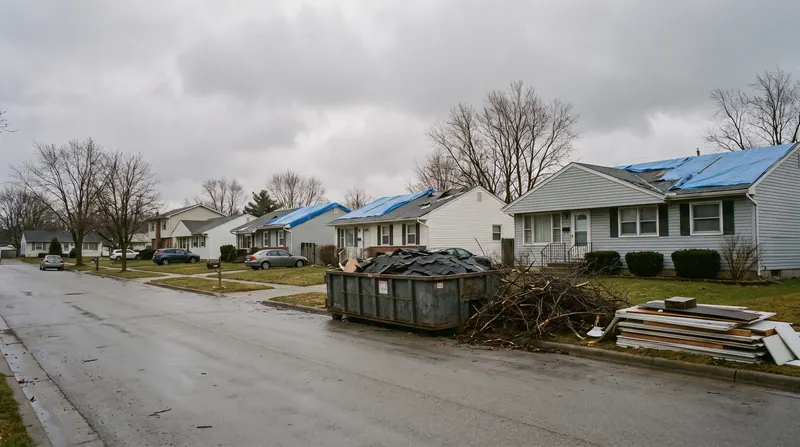
The same job as across the state line, with different rules in the middle of it. Wind and water are often separated on the coast, some cover sits in the wind pool, and the deadlines are Mississippi's own. What does not change: we document, we turn up, and we never tell you what your carrier will do.
People arrive at this page expecting a different service. It is not a different service. It is the same seven-stage sequence with different paperwork inside stage 04 — and being clear about which is which saves a lot of misunderstanding in week two.
The opening photographed before it is covered, every finding shot wide and close, dates and locations on all of it, and the whole set handed to you whether or not you hire us.
Call, tarp, inspection, claim, scope, build, close-out. The stages do not change at a state line — only the paperwork inside stage 04 does.
We do not file for you, negotiate for you, take an assignment of your benefits, or tell you what your carrier will decide. That is identical in both states and it is not negotiable in either.
Coastal policies frequently separate wind damage from water damage, sometimes into different policies entirely. Which one covers what on your house is a question for your declarations page, not for a roofer.
Some coastal properties are covered through the state's wind pool rather than a standard carrier, which changes who you ring and what the paperwork looks like. It does not change what a roof needs.
Filing windows and suit limitations are set by your policy and by Mississippi law, and they are not the same as Louisiana's. Read your own policy, and read it early rather than in week four.
No claim outcome is stated or implied on this page. Nothing here predicts an approval, a denial, a payout, a settlement figure or a deductible, and nothing here is advice about your policy. Those belong to you and your carrier.
A carrier does not act on how bad it looked. It acts on a slope, a date, a location and a photograph. So the report is built that way: everything mapped to where it is on the roof, including the findings that do not help.
You get that file whether or not you use us for the work, and you get it in a form you can forward — not locked inside somebody's portal.
This is the single most useful ten minutes available to a coastal homeowner, and almost nobody spends it. Your declarations page is the front section of your policy: it names the carrier, the covered perils, the limits and — the part that matters after a storm — how each deductible is calculated.
On the Mississippi coast that page frequently holds surprises. Wind and hail may sit with a different insurer from the rest of the cover. A named-storm deductible may be a percentage of the dwelling limit rather than a flat figure, which behaves very differently from the number people remember from their car insurance. Some properties carry cover through the state's wind pool, which changes who you notify and what the claim looks like administratively.
We are not going to interpret it for you. A roofing contractor reading your policy back to you with an opinion attached is exactly the overreach this page exists to avoid. Ring your carrier, ask them to walk you through the deductible structure, and write down what they say with the date and the name of the person who said it. Then you and we can both talk about the roof, which is the part we are qualified to talk about.
No. Not a figure, not a range, not "what usually happens". No page on this site states or implies a claim decision, an approval, a payout or a deductible, and a contractor who offers you one is selling certainty they do not have.
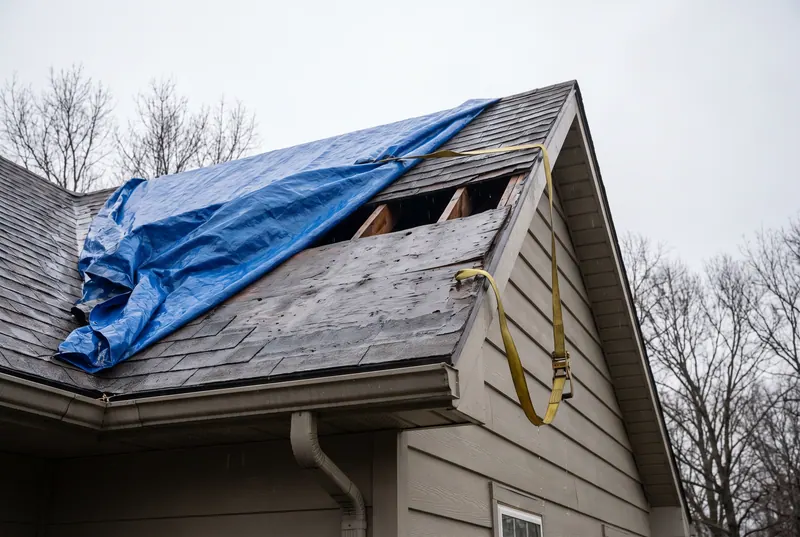
Wind damage has distinct visual signatures — creased tabs, directional patterns across a slope, fresh exposure with clean edges — and photographs of them are the substantive response. We document what is there and you take it back to your carrier. What they then decide is theirs.
Yes, along the Gulf Coast and inland. Ask any contractor who turns up after a storm where their office is and how you reach them in February.
Mississippi's residual market for wind and hail coverage on the coast, for properties that cannot readily get it in the standard market. If your cover is placed there, the claim runs through a different route than a standard carrier claim. Your policy documents say which applies to you.
No. Adjusting a claim on a policyholder's behalf is a licensed activity and a roofing contractor is not that. We document the damage, write a measured scope, attend the inspection and build what is agreed. The claim stays yours.
Sooner rather than later, because evidence fades, tarps thin and it becomes harder to attribute damage to a particular night. Your actual deadline is in your policy and in state law — read it, or ask your carrier to read it to you.
Often, yes: heavier fastening, a sealed deck, different underlayment. Those are choices with prices, and they appear on our estimate as separate lines so you can see exactly what you are choosing and what it costs. Whether anybody else contributes to that cost is a question for your carrier.
No. This page describes how the process is shaped and what we do inside it. Your policy, your property and your deadlines are specific to you, and the people to ask about them are your carrier and, if it comes to it, a licensed professional.
Describe what you can see from the ground and we will tell you whether this is a tarp-tonight problem or a Tuesday problem — (865) 555-0172.
Describe what you can see from the ground. We will tell you whether this is a tarp-tonight problem or a Tuesday problem — and we will say so either way.
These settings are stored on this device only.
This site has not been audited against WCAG, so it does not claim a conformance level. If something here is unusable, the phone number at the top of every page reaches a person.