
Photograph it before it is covered
Wide and close, dated and located, on every opening. Once a tarp is on, nobody can see what was underneath — and that is the shot homeowners most often do not have.
Every page on this site belongs to one stage of a storm job. Open the stage you are in.

This is the stage with the least movement and the most anxiety, so this page is unusually blunt about which parts of it are ours and which are not. We document, we measure, we turn up to the inspection, and we build. We do not predict what your carrier will do — nobody outside it can.
Most of the trouble in this trade happens where a contractor's role quietly expands into things a contractor is not. The second list is as important as the first, and it is not a disclaimer — it is how the work is actually run.
Wide and close, dated and located, on every opening. Once a tarp is on, nobody can see what was underneath — and that is the shot homeowners most often do not have.
Slope by slope, in the line-item format estimating software uses, so the two documents can be laid side by side rather than argued about in adjectives.
You should not have to discuss shingle damage with a professional on your own. We are up there, showing what we found and where, in person.
Photographs, measurements, dates and the report — yours to keep and yours to use, whether or not you ever hire us for the work.
Not a decision, not an approval, not a denial, not a payout, not a settlement figure, not a deductible. Nobody outside your carrier can, and anybody who does is guessing with your money.
Adjusting a claim for a policyholder is a licensed activity and it is not what a roofing contractor is. We document and we build. Your claim stays yours.
No assignment of benefits at a kitchen table, no contract that only becomes a price after a carrier says a number. You get a scope with figures on it before you decide anything.
A roofer ringing your carrier does not reorder an assignment queue. We attend the inspection when it is booked; we do not claim to book it.
No claim outcome is stated or implied on this page. Nothing here tells you what will be approved, denied, paid or deducted, and nothing here should be read as advice about your policy. Those belong to you and your carrier.
Seven steps, of which two are almost entirely other people's calendars. We show them because a three-step graphic that leaves the waiting out is the reason people ring their roofer at seven in the morning.
Get the roof looked at. If the damage is minor, a claim that goes nowhere still sits on your record. Deciding with photographs in front of you is different from deciding with a neighbour's opinion.
You file, not us. A claim number appears more or less instantly, which is why this step feels fast and everything after it feels slow.
Your file joins a queue for an adjuster. After a regional event, carriers bring in catastrophe adjusters from out of state, and contracting, licensing and routing all take days.
An adjuster walks the roof. We are there with the file, the measurements and the photographs of what was under the tarp.
A line-item document from the carrier's estimating software. We put ours beside it in a second column so you can see, item by item, where they differ and why.
Anything the carrier's scope does not include is priced separately and plainly, so you always know which part of the bill is the claim and which part is your choice.
The work, then the final photographs, the completion certificate your carrier asks for, the invoice, and a written statement of what we stand behind.
A squall line across Knoxville on a Saturday night opens several thousand roof claims by Monday morning across one region. Everything downstream of that — adjusters, dumpsters, colour-matched material, a dry morning — is being asked for by all of those houses at once.
None of that is a complaint about carriers and none of it is a promise about your file. It is the shape of a storm month here, described so that you can plan around it instead of spending it refreshing a claims portal.
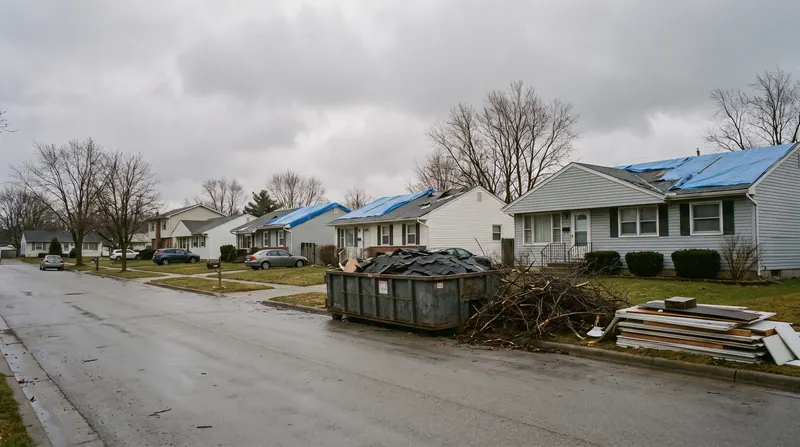
No. We will not estimate it, hint at it, or tell you what usually happens. Your policy, your carrier and your evidence decide that, and a roofing contractor who implies otherwise is selling certainty they do not have.
Usually it helps. It costs nothing here and it means you are deciding whether to open a claim with photographs in front of you rather than a guess. If what we find is unlikely to justify a claim, the report says exactly that.
In our experience of storm weeks here, three to nine days from filing to an adjuster on the roof, then a week or two to a scope, then material and weather. About a month end to end when nothing goes sideways. That is a description of a pattern, not a commitment about your file.
No, and it would be wrong for us to. Adjusting a claim on a policyholder's behalf is a licensed activity. What a contractor can properly do is document the damage, write a measured scope, meet the adjuster, and build what is agreed.
Read your own declarations page, or ring your carrier and ask them to read it to you — particularly how the deductible works for a named storm, which is often structured differently from an ordinary one. Ten minutes, and almost nobody spends it.
It is a proposal to misstate the cost of work to an insurer, and it is a bad idea for the homeowner as much as the contractor. Walk away from it, and be wary of everything else that firm tells you.
That is what the second column is for. We document the difference, price it plainly, and you decide what to do about it. What happens next between you and your carrier is theirs and yours — we supply evidence, not predictions.
It depends on your policy and on the event, and Louisiana has had special claim windows after major hurricanes. Read your policy, and do not wait: evidence fades, tarps thin, and it gets harder to attribute damage to a particular night.
Ring it through and we will triage it on the phone — (865) 555-0172. If typing is easier, this reaches the same desk.
Describe what you can see from the ground. We will tell you whether this is a tarp-tonight problem or a Tuesday problem — and we will say so either way.
These settings are stored on this device only.
This site has not been audited against WCAG, so it does not claim a conformance level. If something here is unusable, the phone number at the top of every page reaches a person.