
Mon-Fri 9am-5pm Knoxville & the Gulf South Storm line: (865) 555-0172
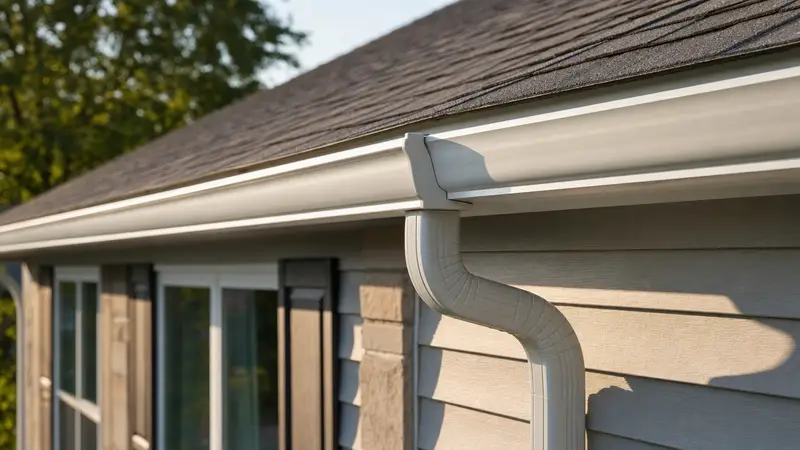
A white seamless gutter and downspout elbow running along the eave of a brown shingle roof on a beige clapboard house
Stage 05 The scope

Roofing accessories

Water almost never gets in through the middle of a shingle. It gets in at the edges, the joints and the holes somebody cut on purpose — which is why the accessory lines on a scope are the ones worth reading twice.

Straight about this job

The parts that decide whether a roof leaks

Pipe boots and penetration flashing

Every vent stack, flue and fan is a hole cut through a watertight surface on purpose. The rubber collar around it is the single most common failure we photograph, and it is cheap to replace with the roof already open.

Step, valley and wall flashing

Where the roof meets a wall, a chimney or itself. Reusing tired flashing under new shingles is the classic way to make a roof look finished and leak in two seasons.

Drip edge and starter course

Metal at the eaves and rakes that pushes water into the gutter instead of behind the fascia. It is a line item because it costs money, and leaving it off is how a number gets made to look smaller.

Ridge and intake ventilation, as a pair

Exhaust at the ridge only works if there is intake at the soffit to feed it. Adding one without the other is a common and expensive way to make an attic worse rather than better.

Gutters, downspouts and guards

A roof is only half a drainage system. Guards are worth discussing honestly: they help with leaves and do very little about pine needles or shingle grit, and anyone telling you otherwise has one to sell.

Ice, sun and the things that age fast

Pipe collars, sealant beads and exposed fasteners have a shorter life than the shingles above them. They belong on a maintenance list, not on a decades-long assumption.

In order

How these land on your scope

  1. They get photographed at the inspection

    Boots, flashing, valleys and vents are close-up shots in the report, so you can see the condition of each one rather than take our word for it.

  2. They get their own lines, not a lump

    Each item is priced separately. Where a claim is open you can see which accessories the carrier scoped and which ones the roof needs anyway.

  3. They get replaced while the roof is open

    Doing a pipe boot with the shingles already off costs a fraction of doing it as a call-out in two years. That is the whole argument, and it is the only one we will make for it.

Start it — (865) 555-0172

Straight answers

Reasonable questions about the small parts

Can I reuse the flashing I already have?

Sometimes, on a repair, if it is sound and the shingles around it can be lifted without damage. On a full replacement it is usually false economy: the labour to work around old flashing costs more than the metal to replace it.

Are gutter guards worth it?

Depends entirely on what falls on your roof. They earn their keep under broadleaf trees and disappoint under pines. We will tell you which one you have before quoting them.

How do I know if my attic ventilation is wrong?

A hot upstairs in summer, frost or damp on the underside of the deck in winter, and shingles ageing faster on one slope than another are the usual signs. It is measured at inspection rather than guessed.

Do accessories have to be done with a whole roof?

No. Boots, flashing repairs, vents and gutters are all perfectly sensible standalone jobs, and if that is all your roof needs, that is what the report will say.

Why are these listed separately instead of included?

Because a single bundled figure cannot be compared with anyone else's. Separate lines let you put two estimates side by side and see exactly where they differ.

Day 0 stage one

Get into the queue

Ring it through and we will triage it on the phone — (865) 555-0172. If typing is easier, this reaches the same desk.

  • The inspection and the photo report cost nothing.
  • You keep the photographs whether or not you hire us.
  • No claim outcome, payout or deductible is ever implied.

Tell us what you can see

Please enter your first name.

Please enter a phone number we can reach you on.

That email address doesn't look right.

No obligation, and no claim outcome is implied by anything on this form. Faster: (865) 555-0172.

Got it. Someone will call you back — usually the same day.

Start at stage one.

Describe what you can see from the ground. We will tell you whether this is a tarp-tonight problem or a Tuesday problem — and we will say so either way.

Call the storm line Inspection