
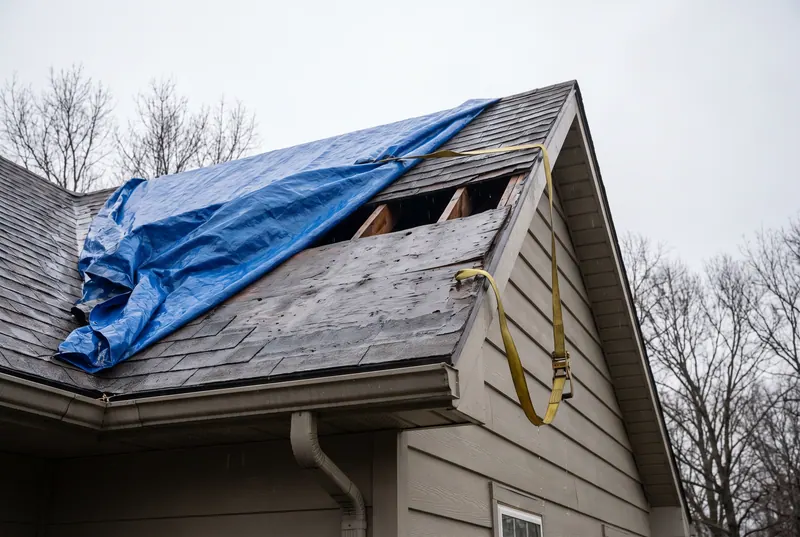
The most valuable photograph in a storm claim is almost always one that does not exist. It is the wide shot of the open roof, taken before the tarp went on, with enough of the house in frame to prove it is your house. Everybody has the after. Almost nobody has the before.
This is what to take in the first hour, in the order we would take it. None of it requires you to go on the roof, and you should not go on the roof.
Stay on the ground. A storm-damaged roof has loose decking, hidden nails, wet shingle and no way of telling you which sheet is soft until you are through it. Nothing on this list is worth a ladder.
Before you start
Two settings, thirty seconds. Turn on your phone's location tagging for the camera if it is off, because a geotag is a quiet, boring corroboration of where a photograph was taken. And check that the date is right — it always is, but the one time it is not, it is the one time it matters.
Then use the camera app, not a messaging app. Photographs sent through chat apps are recompressed and stripped of their data. Take them properly, then send copies.
From the street, four corners
Walk to the far side of the road and photograph the whole house, front on. Then repeat from each accessible corner of the property, so you end up with four wide shots that between them show every elevation. Keep the ground and the sky in frame. These are the establishing shots: they prove address, date, weather and the overall state of the roof in one image each.
If a neighbouring roof is visibly damaged too, get one frame that includes both. A street-wide event is easier to attribute to a storm than a single roof is.
The damage itself, wide then close
For every area of damage, take a pair: one wide enough to show where on the house it is, and one zoomed as far as your phone will go without going digital-blurry. A close-up with no context is unusable, because nobody can tell which slope it came from. A wide shot with no close-up shows nothing.
What to look for from the ground:
- Missing or lifted shingles, and any tab lying in the yard or the flowerbed — photograph those where they landed before you tidy them.
- Creased shingles: a horizontal fold across a tab where wind lifted it and dropped it. It is the classic wind signature and it is visible with a zoom.
- Exposed underlayment or bare deck. That is the shot that matters most.
- Damaged ridge caps, missing flashing, a bent or displaced vent, a leaning stack.
- Gutters and downspouts — dents, separation from the fascia, granules collected in the bottom.
- Siding, windows, fascia, soffit, the garage door, the fence, the AC condenser fins. Roof claims often include these and people photograph none of them.
- Fallen limbs and where they fell from, and anything a limb landed on.
Inside, ceiling by ceiling
Walk every room including cupboards and photograph any ceiling stain, wet patch, bubbling paint, or water track down a wall, wide and close. Get the attic hatch open if it is safe and photograph any daylight visible through the deck — daylight in an attic is unambiguous and it is very hard to argue with.
Put something in frame for scale on the close shots. A hand, a ruler, a coin. A 300mm stain and a 30mm stain look identical in a cropped photograph.
Then photograph any of your belongings that got wet, before you move them or throw them out. This is the category people most reliably skip and most reliably regret.
Video, once, narrated
One continuous walk-round of about two minutes, outside then inside, talking as you go: the date, the address, what you are looking at, when the storm came through. It is not a substitute for stills — video frames are lower resolution than you think — but it establishes sequence and continuity in a way a folder of images does not, and it takes two minutes.
Then, and only then, cover it
If water is coming in, the tarp goes on as soon as somebody safe can fit it. But once it is on, everything underneath it is out of sight for the rest of the month. If we are fitting it, we photograph the opening first and hand you that set — that is a fixed part of how the visit runs, not a favour. If somebody else is fitting it, or you are, ask for two minutes with a camera first.
Keeping it
Get everything off the phone the same day: email it to yourself, put it in a cloud folder, anything with a second copy. Phones get dropped in wet weeks. Name the folder with the date of the storm.
Alongside it, start a plain text file or a notepad: every call, with the date, who you spoke to and what they said. Claim numbers, adjuster names, appointment times, the name of the person who fitted the tarp. This costs ten seconds a time and by week four you will have a record nobody can dispute and you will not have had to remember any of it.
None of this is about building a case against anybody. It is about making sure that when somebody eventually stands on your roof — ours, or your carrier's, or both on the same morning — the conversation is about evidence that already exists rather than about what everybody thinks they remember.