
Evidence, not adjectives
Every finding is photographed, dated, and yours to keep — including the findings that do not help your case.
Every page on this site belongs to one stage of a storm job. Open the stage you are in.
Roofing in TN is rarely a roofing decision. It is a month of waiting, photographs and paperwork with a hole in your house. Granite Ridge runs that month as a queue you can see — and tells you which days nothing will happen.
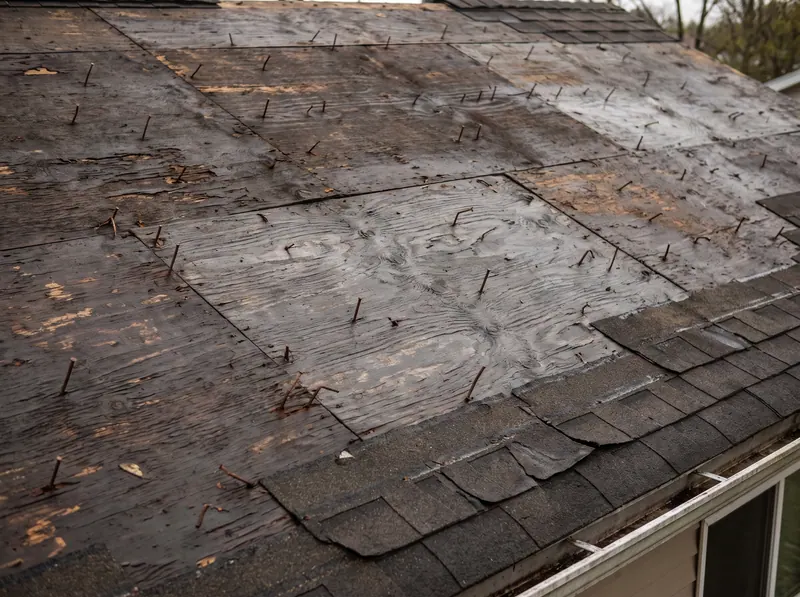 What the tarp is holding back
 Not a rating, not a volume, not a warranty term. Those belong to companies that have earned them and can prove them. These are things about how the work is run, which anyone can check while it is happening.
Every finding is photographed, dated, and yours to keep — including the findings that do not help your case.
We tell you which days nothing will happen and why, before they happen, instead of letting you ring us every morning.
The person who photographed your roof, the scope, the crew and the final invoice all come from the same phone number.
Seven stages and two stretches of nothing. The stretches are drawn here because they are most of the month, and because a three-step process graphic that leaves them out is the reason people ring their roofer at seven in the morning.
You describe what you can see from the ground. We triage it on the phone and tell you whether this is a tarp-tonight problem or a Tuesday problem.
Nobody is sold anything on this call. We ask where the water is, how old the roof is, and whether you have already opened a claim — and then we book the right visit.
If the roof is open, covering it comes first. A tarp is not a repair — it is a decision to stop the damage growing while everything else takes its time.
We photograph the opening before we cover it, because once a tarp is on, an adjuster cannot see what was underneath. Those photographs belong to you.
Someone walks the roof and photographs every finding — the ones that help your case and the ones that do not.
You get the photo set whether or not you hire us. Plenty of roofs we inspect need a repair, not a replacement, and that is what the report says.
You file. An adjuster is assigned. This is the part of the job with the least movement and the most anxiety, so we say plainly what is and is not happening.
We do not decide your claim and we never predict one. We give the carrier a documented scope, we meet the adjuster on the roof, and we tell you what we saw.
Materials, labour, decking, haul-off, line by line. If your carrier approved a different scope than the roof needs, you will see both columns.
Anything not covered is priced separately so you always know which part of the bill is the claim and which part is your choice.
Tear-off, deck inspection, dry-in, install, and a magnet run over the grass. You get told the night before, and you get told when we leave.
Decking that is soft gets replaced and photographed, not papered over. The change is priced before anyone nails anything down.
Final photographs, the certificate of completion your carrier needs, the invoice, and the written terms of what we stand behind.
The last document is the one people forget to ask for: a plain statement of what is covered, for how long, and what voids it. It is in your contract, not on a banner.
After a named storm, one adjuster covers a parish. Your file is not being ignored and it is not being fast-tracked; it is in a queue behind several hundred other roofs that were also opened up on the same night.
What we can do in that window is make sure the file is complete before it is opened — dated photographs, a measured scope, and the shot of the damage taken before the tarp went on, which is the one people most often do not have.

Storm work has a claim stage in the middle. Everything else is the same queue with that stage removed.
Tear-off, a real look at the decking underneath, dry-in and install — with the deck repairs priced before anyone nails anything down.
Read more
Leaks, lifted shingles and failed flashing, found where they actually start rather than where the stain shows up.
Read more
Emergency tarping, then the documentation your carrier needs. We photograph the opening before we cover it.
Read more
A walk of the roof and a photograph of every finding — including the ones that do not help a claim. Yours to keep either way.
Read more
Seamless gutter installation, repair and guards that move TN rain away from the foundation instead of into it.
Read more
Standing-seam metal, slate, Spanish tile and cedar shake — installed to the manufacturer's published instructions for that system.
Read more
The entries below all come from one week's work after Knoxville took a squall line. They are in the order they happened, not in order of how good they are.
Jun 14, 2026 Day 1 · The tarp
Half the street lost shingles overnight. They had a tarp on our slope by four in the afternoon and photographed the hole before they covered it, which the adjuster later asked for.
Denise B.
Baton Rouge
Jun 16, 2026 Day 3 · The inspection
Two other companies told me the whole roof was gone. Granite Ridge found a cracked pipe boot, showed me the photo, and fixed it. I did not need a claim at all.
Marcus T.
Prairieville
Jun 19, 2026 Day 6 · The claim
The waiting was the worst part and they were honest about it — nothing would move until the adjuster came out. They told me that on day three instead of letting me call every morning.
Priya S.
Denham Springs
Jun 23, 2026 Day 10 · The scope
Two columns on the estimate: what the carrier approved and what the roof actually needed. We could see exactly which difference we were choosing to pay for.
Bill & Janet H.
Gonzales
Jun 30, 2026 Day 17 · The build
They called the night before, arrived at seven, found four soft sheets of decking, priced them before replacing them, and ran a magnet over the yard twice.
Carlos M.
Zachary
Jul 4, 2026 Day 21 · The build
Weather pushed us a day. Somebody rang to say so rather than just not turning up, which after three weeks of this process meant more than it should have.
Ashley W.
Covington
Jul 12, 2026 Day 29 · The close-out
Completion certificate, the full photo set, and a page explaining what is covered and what voids it. First contractor who handed me that without being asked.
Ray D.
Livingston
It usually helps. If the damage turns out to be minor, a claim that gets denied still sits on your record. We photograph the roof first so you are deciding with evidence rather than guessing. We never tell you what your carrier will do — that is not ours to say.
If water is coming in, that is the call that jumps the queue — same day wherever we can reach you. If it is not actively leaking, we will book the inspection instead and tell you honestly that a tarp would be theatre.
Because six of those days are an adjuster's calendar and several more are material lead times after a big storm. The parts we control are fast. We show the waiting on this page at its real length rather than hiding it behind a three-step graphic.
A walk of the roof, photographs of every finding — including the ones that do not help a claim — and a plain verdict: repair, replace, or leave it alone. You keep the photographs whether or not you hire us.
No. Nobody outside your carrier can, and anyone who does is guessing with your money. We can tell you what the roof needs and what it costs to do properly.
Yes — repairs, replacements, gutters, siding and commercial low-slope work all run through the same sequence, minus the claim stage.
The phone is faster and it is answered by somebody who can triage what you are describing. If it is easier to type it, this reaches the same desk.
Describe what you can see from the ground. We will tell you whether this is a tarp-tonight problem or a Tuesday problem — and we will say so either way.
These settings are stored on this device only.
This site has not been audited against WCAG, so it does not claim a conformance level. If something here is unusable, the phone number at the top of every page reaches a person.