
Stage 01 · The call
Renata Alvarez
Dispatch
Answers the storm line and triages what you are describing. Decides whether you need a truck tonight or an inspection on Tuesday, and says which out loud rather than booking whichever is bigger.
Every page on this site belongs to one stage of a storm job. Open the stage you are in.
Seven stages, seven people who own one each. You are told who is coming, what they are there to do, and who picks the job up when they hand it on.
A roof changes hands several times between the first call and the last invoice. These are the hands, in the order they touch it.
Stage 01 · The call
Dispatch
Answers the storm line and triages what you are describing. Decides whether you need a truck tonight or an inspection on Tuesday, and says which out loud rather than booking whichever is bigger.
Stage 02 · The tarp
Tarp lead
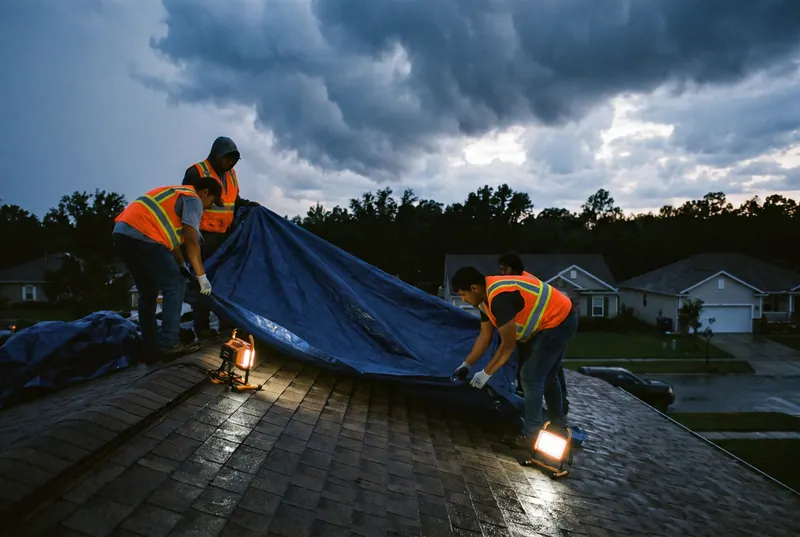
Runs the emergency covers. Photographs the opening, then covers it — in that order, every time, including at two in the morning when nobody would know the difference.
Stage 03 · The inspection
Inspection & documentation
Walks the roof and photographs every finding, including the ones that weaken a claim. Writes the verdict in plain English: repair, replace, or leave it alone.
Stage 04 · The claim
Adjuster meetings
Meets your adjuster on the roof and shows them what was found. Never predicts a decision, a payout or a deductible, and will tell you when a call to the carrier would not move anything.
Stage 05 · The scope
Scope & estimating
Writes the line-by-line scope — materials, labour, decking, haul-off — and sets the approved column beside the needed column so the difference is visible before you choose.
Stage 06 · The build
Install superintendent
On site from tear-off to the magnet run. Stops the job when decking is soft, photographs it, prices it, and waits for your yes before anything is nailed down.
Stage 07 · The close-out
Close-out & paperwork
Final photographs, the completion certificate your carrier asks for, the invoice, and the written page of what is covered and what voids it.
Most complaints about roofers are not about roofing. They are about a job passing between people and the homeowner falling down the gap in between.
The same line reaches dispatch, the scope desk and the superintendent. Nobody is asked to explain their roof from the beginning twice.
Photographs, measurements and dates move between stages as one file. What the inspector saw is what the estimator prices.
A call before the crew arrives and another when they leave, so a day of noise is never also a day of guessing.
The roles above are the roles we hire for. What the work is actually like — the hours, the weather, the paperwork — is set out plainly on the careers page.
Describe what you can see from the ground. We will tell you whether this is a tarp-tonight problem or a Tuesday problem — and we will say so either way.
These settings are stored on this device only.
This site has not been audited against WCAG, so it does not claim a conformance level. If something here is unusable, the phone number at the top of every page reaches a person.