
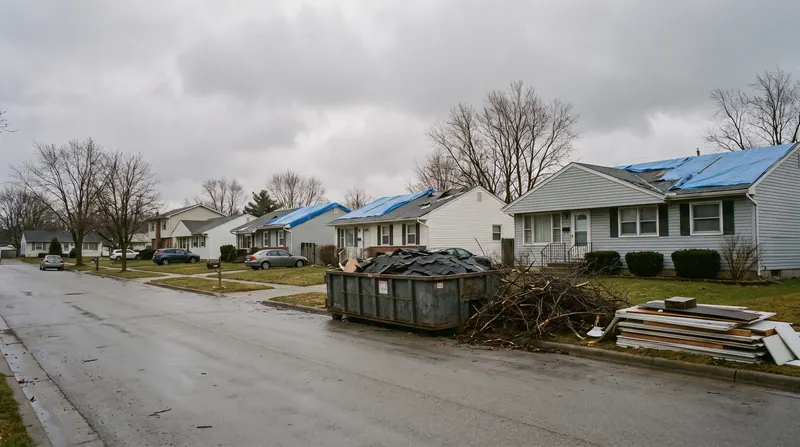
On the home page of this site there is a band in the timeline that is just empty — a stretch labelled "waiting on an adjuster" drawn at roughly its real proportion of the month. Visitors ask about it more than about anything else on the page, which tells you something. Nobody has ever explained the gap to them; they have only ever been on the wrong end of it.
So here is the gap, in as much detail as we honestly have.
What actually happens between filing and a roof visit
You call your carrier or file online. A claim number is generated more or less instantly, which is why filing feels fast and everything afterwards feels slow. That number then enters a queue for assignment.
In an ordinary week, assignment is quick, because the adjusters attached to a region are handling an ordinary week's worth of losses — a kitchen fire here, a burst supply line there, a tree on a car. After a squall line moves across Knoxville on a Saturday night, a few thousand claims are opened by Monday morning across the same region, and they are all roofs, and they all want the same person on a ladder.
Carriers respond by pulling in independent adjusters from outside the state — catastrophe crews who travel to events. That process is not instantaneous. Somebody has to be contracted, licensed to work the state, briefed, given a territory and given a route. From filing to a name on your file is often two to four days. From a name to a booked appointment is usually another two to five, because that adjuster is routing a day of inspections geographically and your street is a stop on a line.
Six days, give or take, is what that adds up to in our experience of storm weeks here. It is not a promise and it is not a rule; it is the shape of the thing.
The things that genuinely move it
A short list, and it is short on purpose.
- Filing early. Not because early files get priority, but because the queue is chronological and it grows fast. A claim opened Sunday morning sits ahead of one opened Wednesday.
- Being reachable. An enormous number of appointments slip because the adjuster's scheduling call went to a voicemail nobody checked. Answer unknown numbers for the fortnight after a storm. Give the carrier a second number.
- Being flexible on the slot. Routing is geographic. If you can take the awkward Tuesday morning, you get seen on Tuesday morning.
- Reporting an active leak, accurately. Most carriers will move an inspection forward for ongoing interior water. Say so plainly if it is true. Do not say so if it is not — you are burning credibility you will want later.
- A complete file waiting for them. This does not move the appointment, but it moves everything after it. Dated photographs, a measured scope and the shot of the damage taken before the tarp went on mean the visit is a confirmation rather than a discovery.
The things that do not move it
Ringing the carrier every morning does not move it. We know this is unsatisfying. The person answering that phone has no ability to reorder the assignment queue, and the call is logged as contact rather than as escalation. Two calls, three days apart, with a specific question each time, get further than nine calls asking whether there is any news.
A roofer ringing on your behalf does not move it either, and any roofer who tells you they have a relationship that jumps the queue is selling you something. We attend the inspection when it is booked. We do not pretend we can book it.
Signing something at the door does not move it. In the week after a storm, people come round with contracts that assign your claim benefits to them in exchange for an implied promise of speed. The speed is not theirs to give.
Nothing in this note predicts a decision, a payout, an approval or a deductible on your claim. Those belong to you and your carrier. What we describe here is the scheduling mechanism, which is a different thing entirely — and the only part of it we can honestly speak to.
What to do with six days
Practical, in rough order of usefulness. Photograph the interior damage as it develops, dated — a ceiling stain on day two and the same stain on day six is a more persuasive pair of images than either one alone. Find and read your declarations page, particularly the deductible structure, because named-storm deductibles work differently from ordinary ones and it is better to learn that now than on day fourteen. Keep receipts for anything you spend to stop the damage growing: a tarp, a dehumidifier, a night in a hotel if the house is not habitable. Write down every phone call with a date, a name and what was said, because in six weeks you will not remember and the note takes ten seconds.
And then, genuinely, stop. The tarp is doing its job. The file is doing its job. There is a stretch of this process where the most useful thing available to you is to not spend the week refreshing a claims portal, and we would rather tell you that on day three than let you find out on day nine.
Why we say all this out loud
Because the alternative is what most of this industry does, which is to imply the wait is somebody's fault and hint that hiring them will end it. That sells work in week one and produces a furious customer in week two.
We would rather show you the empty band on the timeline, at its real length, and be the company that was right about it.