
Mon-Fri 9am-5pm Knoxville & the Gulf South Storm line: (865) 555-0172
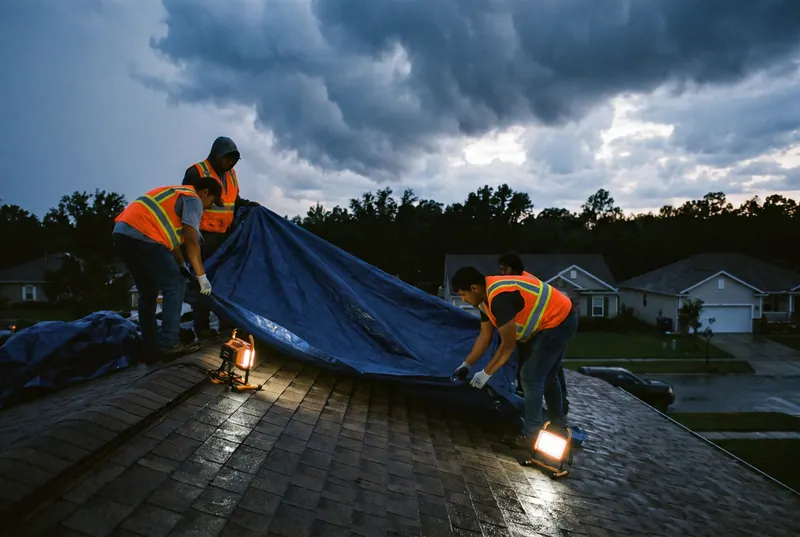
Three roofers in high-visibility vests dragging a blue tarp across a shingle roof at dusk, lit by two portable work lamps under heavy storm cloud
Stage 02 The tarp

Storm restoration in Knoxville

TN weather does not make appointments. The first job is to stop the damage growing. The second is to make sure somebody photographed what was there before a tarp hid it — because once the sheet is down, nobody can see underneath it.

Straight about this job

What the first visit actually does

Photographs before the cover

Every opening is shot wide and close before anything goes over it — wide enough to establish which house and which slope, close enough to show what failed. That set is yours immediately, whether or not you hire us for the work.

A tarp fitted rather than thrown

Run from the ridge, past the damage, over the eave, so water travelling under it still leaves the roof. Held with battens or sandbags along the perimeter and strapped over the top, not weighted with two bricks and hope.

An honest answer about whether you need one

If the roof is not open, a tarp is theatre: it puts holes in a deck that did not have any, and it makes the roof harder to inspect. We will say so on the phone and book the inspection instead.

One company through the whole sequence

The person who covered the roof, the inspection report, the scope, the crew and the final invoice all come from the same phone number. Nothing is handed to a subcontractor you have never spoken to.

The waiting named in advance

We tell you which days nothing visible will happen and why, before they happen, rather than letting you ring every morning to find out. Most of a storm month is other people's calendars.

No claim outcome implied, ever

We do not tell you what your carrier will decide, what you will be paid, or what your deductible will be. Nobody outside your carrier can, and anyone who does is guessing with your money.

In order

The first seventy-two hours, in order

  1. The call, triaged

    You describe what you can see from the ground — never from a ladder. We work out whether this is a tarp-tonight problem or a Tuesday problem and tell you which, plainly, on the phone.

  2. Cover it, after photographing it

    Water coming in gets a crew the same day wherever we can reach you. The opening is documented first. If the wind is still up, we give you the earliest safe window rather than pretending there is a sooner one.

  3. Walk it with a camera

    Within a day or three, somebody walks the roof and photographs every finding — including the ones that do not help a claim. Plenty of roofs need a repair rather than a replacement, and the report says so when that is the answer.

  4. Hand you a file, not a pitch

    Dated photographs, a measured scope and a plain verdict. What you do with it is yours: open a claim, pay for a repair, or do nothing for now. The photographs are yours either way.

  5. Refit the tarp if the calendar slips

    A tarp in this climate is a matter of weeks, not months. UV thins the weave and the fasteners work in the wind. If your build date moves past its usable life, the sheet gets replaced — that is a normal event, not a failure.

  6. Into the rest of the queue

    Stage 04 is the claim and the adjuster's calendar; stage 05 is numbers on paper; stage 06 is the build. Each has its own page, and each one tells you what is happening and what is not.

Start it — (865) 555-0172

Straight answers

Storm restoration — the questions we get at two in the morning

How fast can you get a tarp on?

If water is coming in, that call jumps the queue and we go the same day wherever we can reach you. If it is not actively leaking, we will book the inspection instead and tell you honestly that a tarp would be theatre.

Should I climb up and look first?

No. A storm-damaged roof has loose decking, hidden nails and wet shingle, and it will not tell you which sheet is soft until you are through it. Photograph everything from the ground and from inside, and leave the roof to somebody with a harness.

What if a neighbour already tarped it for me?

Then photograph it before we lift a corner, and again with the corner lifted. Two sets is not excessive. The shot nobody has later is the one of the opening before it was covered.

Does a tarp fix the leak?

No. It stops the damage growing. Nothing underneath is better than it was — wet decking stays wet and will still need replacing when the roof is opened up. What a tarp buys you is the month that the rest of this process takes.

Do you charge for storm inspections?

No. The inspection and the photo report cost nothing and carry no obligation to use us for the work. You keep the photographs regardless.

Are you going to knock on my door after a storm?

No. If somebody turns up on your step with a contract and an urgent tone, read every line before you sign, and never sign anything that assigns your claim benefits to a contractor at the door.

What about damage that is not the roof?

Photograph it anyway — siding, windows, fascia, soffit, garage door, fence, the AC condenser fins. Storm claims routinely include these and they are the things people most reliably fail to document.

Day 0 stage one

Get into the queue

Ring it through and we will triage it on the phone — (865) 555-0172. If typing is easier, this reaches the same desk.

  • The inspection and the photo report cost nothing.
  • You keep the photographs whether or not you hire us.
  • No claim outcome, payout or deductible is ever implied.

Tell us what you can see

Please enter your first name.

Please enter a phone number we can reach you on.

That email address doesn't look right.

No obligation, and no claim outcome is implied by anything on this form. Faster: (865) 555-0172.

Got it. Someone will call you back — usually the same day.

Start at stage one.

Describe what you can see from the ground. We will tell you whether this is a tarp-tonight problem or a Tuesday problem — and we will say so either way.

Call the storm line Inspection