
An honest verdict, in writing
If a repair is the right answer, that is what the report says. A leak is not automatically a replacement pitch, and a roof that is fine gets told it is fine.
Every page on this site belongs to one stage of a storm job. Open the stage you are in.
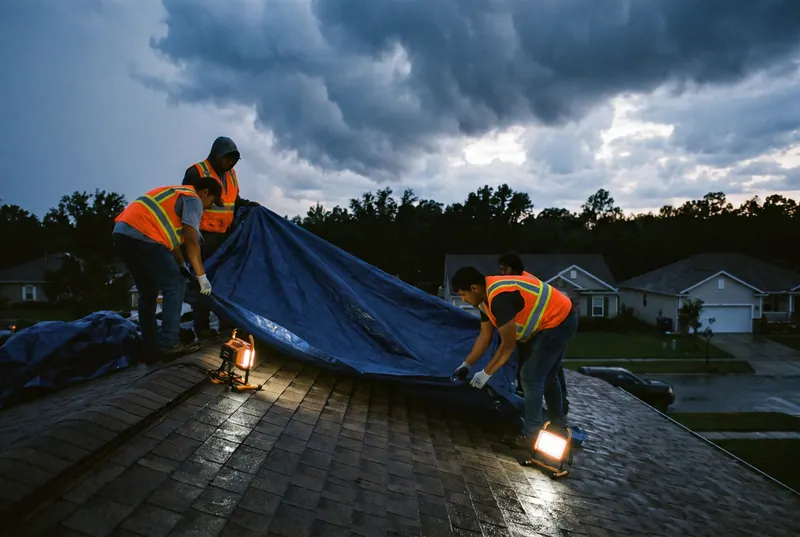
A roofing job produces six documents. Most of the disputes in this trade are about something that was said on a driveway instead of written on one of them. Here is what you should be holding, and at what point in the month you should be holding it.
None of these is unusual and none of them is a favour. They are the ordinary output of a job run properly, and the order matters as much as the contents.
Every finding photographed, dated and located, including the findings that do not help a claim. A written verdict in one sentence: repair, replace, or leave it alone. It is yours whether or not you hire us.
Material by the square, tear-off layers, a stated decking allowance with a per-sheet rate beyond it, flashing and penetrations listed separately, haul-off, labour. Where a claim is open, what the carrier scoped sits beside what the roof needs.
Written before it is needed, because a policy agreed while a crew is standing on a bare deck is not a policy. It says how a change is discovered, how it is evidenced, how it is priced and who approves it — you do, before the work happens.
The date we are actually holding, not the date that sounds better on the phone. Alongside it, what is due when — and what each payment is for, so a deposit is tied to materials being ordered rather than to a slot being reserved.
The document a carrier asks for at close-out, plus photographs of the finished work and of anything that was replaced along the way. Handed over without being chased for it.
What is covered, what is excluded, how a claim is reported and what voids it — set out in plain English in the contract you sign, rather than summarised as a number in a headline.
Every one of these is checkable while it is happening, which is the only kind of promise worth making on a website. There is no rating on this page, no job count and no term of years, because those would be claims rather than conduct.
If a repair is the right answer, that is what the report says. A leak is not automatically a replacement pitch, and a roof that is fine gets told it is fine.
We tell you which days nothing will happen and why, before they happen, rather than letting you ring every morning to find out.
Dump trailer on site, tidied at the end of each day, and a magnet run over the grass and the drive before anyone calls it finished.
The person who photographed your roof, the scope, the crew and the final invoice all come from the same company and the same number.
A roof is opened only when the weather allows it to be closed again the same day. If that moves the date, you hear it from us first.
We do not predict a claim decision, a payout or a deductible, and nothing we hand you will imply one. That belongs to your carrier and your policy.
After a named storm, the number of roofing companies in a parish goes up sharply and comes down again by winter. These five questions are how you tell which sort you are talking to.
A warranty length is the easiest thing on a roofing website to print and the hardest to enforce. Rather than invent one, this demo explains how the two kinds of roofing warranty actually work and what quietly voids them.
The photo report, the itemised scope, the change-order policy, the schedule with payment stages, and the contract including its written terms. If any of those five is missing, that is the conversation to have before signing rather than after.
Because decking is the most common surprise in this trade and the worst time to negotiate is when the roof is already open. Agreeing the method beforehand turns a nasty moment into an administrative one.
Take it. The photographs are yours, there is no clause reclaiming them, and a second opinion formed from a proper photo set is a better second opinion.
Granite Ridge Roofing is a fictional company built for a design demonstration, so it holds no licence, no insurance and no accreditation, and this site claims none. For a real contractor those are documents you should verify before letting anyone on your roof, not adjectives on a website.
Of anyone, not only of us. A contractor who hesitates over a written change-order policy has told you how the awkward moment on your roof is going to go.
These settings are stored on this device only.
This site has not been audited against WCAG, so it does not claim a conformance level. If something here is unusable, the phone number at the top of every page reaches a person.