
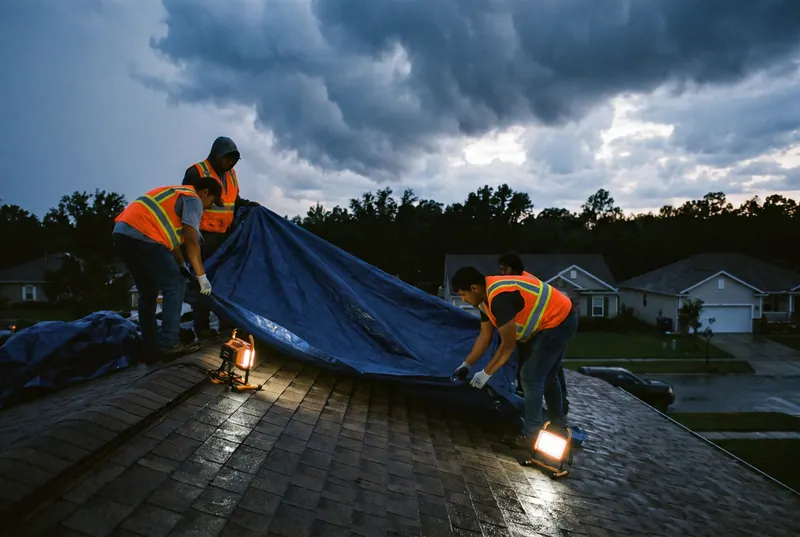
The tarp is the only part of this process that happens fast, which is why it carries more emotional weight than it structurally deserves. People remember the blue sheet going on. They remember it as the moment somebody turned up. It is worth being precise about what that sheet is and what it is doing, because the precision is reassuring in a way that reassurance is not.
What it is
A roofing tarp is woven polyethylene, laminated on both faces, with reinforced hems and brass or nickel grommets set every few feet. The weave is what matters: it is why the sheet can take a strap load without tearing from a grommet, and it is why a hardware-store picnic tarp fails in a fortnight and a heavier one does not.
Fitted properly it is not just laid over the hole. It runs from the ridge down past the damage, over the eave, so water travelling under it still runs off the roof rather than into the fascia. Its top edge is wrapped over the ridge or tucked under the course above so wind cannot get beneath it and lift. The perimeter is held with battens — lengths of timber screwed through the tarp into the deck, which spread the load along a line rather than concentrating it at each fastener — or with sandbags along the edges where fastening into the deck is the wrong call. Straps go over the top and are anchored, not just cinched.
That fitting is the whole job. A tarp that has been thrown over a slope and weighted with two bricks is not a smaller version of this; it is a different thing that happens to be the same colour.
What it does
- It stops the damage growing. The single biggest cost multiplier after a storm is not the hole, it is the next four rain events through the hole. Insulation, ceiling board, wiring and framing are all more expensive than shingles.
- It buys the calendar. The month this process takes is mostly other people's scheduling. A tarp is what makes that month survivable rather than urgent.
- It makes the house habitable. Sometimes the difference between staying and not staying is one slope being dry.
- It marks the roof. Practically: a tarped roof on a street is a visible record that this address had damage on this date, and that turns out to matter more than you would think when you are establishing when a loss happened.
What it does not do
It does not repair anything. Nothing under the tarp is better than it was; it is simply not getting worse as quickly. Decking that is already wet stays wet, and if it has been wet for a while it will still need replacing when the roof is opened up.
It is not permanent, and it is not close. In this climate, a well-fitted tarp with battens and straps is a matter of weeks, not months — UV degrades the weave, the fasteners work in the wind, and the sheet gets thinner every hot afternoon. If your build date slips past the tarp's usable life, the tarp gets refitted. That is a normal event, not a failure.
It does not stop every leak. Wind-driven rain moves sideways and finds edges. A tarp reduces water ingress dramatically; it does not guarantee a dry ceiling in a bad band, and any roofer who tells you otherwise has not been on enough roofs.
And it does not preserve evidence — it hides it. Which brings us to the part people most often get wrong.
Photograph it before you cover it
Once the sheet is down, nobody can see what was underneath. Not you, not us, and not the person who eventually comes to look at the roof. We photograph every opening before we cover it, wide enough to establish which slope and which house, and close enough to show what failed. Those photographs are yours, immediately, whether or not you go on to hire us for the work.
If you or a neighbour fitted the tarp before we arrived, take the photographs before we lift a corner to look, and take them again with the corner lifted. Two sets is not excessive. We wrote a separate note on exactly what to shoot in the first hour, and it is the note we would hand somebody standing in their yard at seven in the morning.
When a tarp is the wrong answer
We turn down tarp requests reasonably often, and it is worth saying why out loud.
If the roof is not open — if what you have is a few lifted tabs, a bruised slope, dented gutters, granule loss in the downspouts — then a tarp is theatre. It puts holes in a deck that did not have holes in it, it makes the roof harder to inspect, and it does not stop anything, because nothing is coming in. What that roof needs is somebody to walk it with a camera in the next couple of days.
If the structure itself is compromised — a tree through the framing, a visible sag, a slope that has moved — a tarp is not a job for anybody standing on it, including us, until somebody has looked at what is holding the roof up. That is a different call and a different trade, and we will say so on the phone rather than send a crew.
And if the wind is still up, nobody goes on a roof. A tarp fitted in 40mph gusts is a hazard to the person fitting it and it will not stay on. We will tell you the earliest safe window and we will not pretend it is sooner than it is.
The honest summary
A tarp is about eight square metres of woven plastic, some timber, some strap and roughly two hours of somebody's evening. It is not impressive. What it is, is the decision to stop the clock on the damage while the slow parts of TN's storm season take their time — and the sooner it is made, the smaller the eventual job.